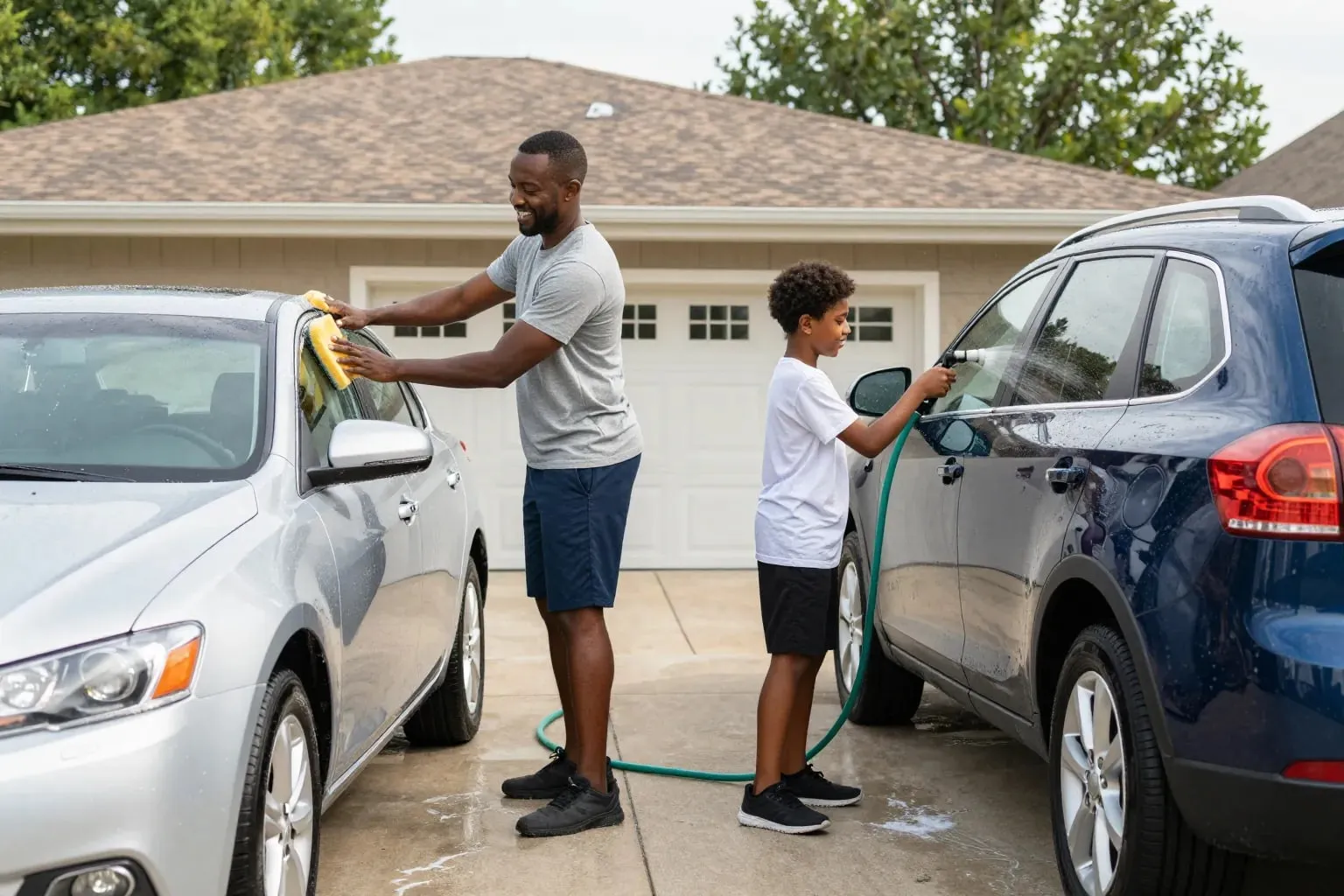
For most families with two or more cars, putting every vehicle on one policy with one company is the simplest setup and often earns a multi-car discount, and bundling with home or renters coverage may lower the total further. But discounts are only half the story. The bigger risks in a multi-car household are gaps: a driver who isn’t listed, a car garaged somewhere else, mismatched coverage, or a vehicle quietly being used for work.
How a multi-car policy works
A multi-car policy lists every household vehicle and every licensed driver on a single contract. A few things are usually shared, and others are set car by car.
- Usually shared across the policy: liability limits, the list of drivers, the billing and renewal date, and policy-wide discounts.
- Usually set per vehicle: collision and comprehensive coverage, their deductibles, and add-ons such as rental reimbursement or roadside help.
That flexibility is useful. You can keep full physical damage coverage on a newer, financed SUV and carry only liability on a paid-off older sedan, all on the same policy.
Every licensed driver in the home generally needs to be disclosed. As Virginia’s DMV notes (opens in a new tab), insurers may consider the driving record of any driving-age person in the household when they set your premium. Leaving someone off can cause trouble at claim time.
Discounts a multi-car household can ask about
The Triple-I (opens in a new tab) and the NAIC (opens in a new tab) both list insuring more than one car with the same company, and buying more than one type of coverage from the same insurer, among common ways to save. Here is what to ask about:
| Discount | What it usually requires | Good to know |
|---|---|---|
| Multi-car | Two or more vehicles on the same policy or with the same insurer | Some insurers require the cars to be kept at the same address |
| Multi-policy (bundling) | Auto plus homeowners, renters or condo coverage with one company | Compare the bundled total against separate policies |
| Good student | A young driver with strong grades | Usually for drivers under a certain age |
| Driver training | Completion of an approved driver education or defensive driving course | Rules vary by state |
| Student away at school | A student living away from home without a car | Eligibility rules differ by insurer |
| Low mileage | Driving fewer miles than average | Some insurers count carpooling |
| Safety and anti-theft features | Qualifying equipment on the vehicle | Varies by insurer |
| Safe driving or claims history | No accidents or violations for a set period | Some insurers also reward long-time customers |
Discounts vary by state and by company. The Triple-I makes an important point: the key to saving is the final price, not the number of discounts. A company with few discounts may still come out lower overall.
When bundling helps and when it doesn’t
Bundling usually means one company handles your auto and your home or renters policy. The benefits are real: one point of contact, sometimes one bill, and often a reduced rate on one or both policies. Some families also find it simpler when a single event, such as a storm that damages both the house and the car in the driveway, involves one insurer.
Still, the Triple-I notes that you may sometimes pay less by buying from different companies than by taking a multi-policy discount. Our approach is simple: we price the bundle and the separate options side by side so you can see the actual numbers before deciding.
Coverage gaps to look for
These are the gaps we see most often when reviewing policies for households with several cars.
Mismatched liability expectations
Since liability limits usually apply to the whole policy, every car carries the same protection for injuries and damage you cause to others. That’s good, as long as the limit is high enough. If your limits were chosen years ago, or set near the legal minimum, they may not reflect what your family has to protect today. Our guide on why state minimum liability rarely protects a family explains how to think about the right number.
Dropping physical damage on the wrong car
Removing collision coverage from an older car can make sense, and the NAIC (opens in a new tab) suggests considering it on older vehicles unless a lender requires it. The gap appears when that “old” car becomes someone’s main ride, or when the family couldn’t actually afford to replace it after a crash. Make that choice deliberately.
Drivers who aren’t listed
Teens who just got licensed, adult children who moved back home, a partner who moved in, or a relative who stays for months can all count as household drivers. Tell your insurer when the household changes. If a teen is joining the policy, our post on adding a teen driver covers timing, assigning drivers to vehicles and ways to keep the cost manageable.
A car kept at a different address
A college student who takes a car to campus, or a vehicle kept at a second home, may need to be rated at where it actually spends most nights. Insurers base pricing partly on where a car is garaged, so an inaccurate address can create problems later. If the student leaves the car at home, ask whether an away-at-school discount applies instead.
Business or gig use
If anyone in the household uses a car for deliveries, rideshare or regular work errands, a standard personal policy may limit or exclude that use. Ask before the first shift, not after the first claim. Our commercial and business-use auto team can explain the options.
Stored or seasonal vehicles
A project car, a convertible that sits all winter, or a car waiting to be sold still needs attention. Some states have strict rules about insurance on registered vehicles. In California, for example, the DMV says (opens in a new tab) you must notify it before cancelling insurance on a registered vehicle, or the registration can be suspended. Depending on your insurer and state, reduced coverage while a car is stored may be possible. Check before you cancel.
Uninsured and underinsured motorist coverage
Uninsured and underinsured motorist coverage protects your family when the at-fault driver has no insurance or too little, as the Triple-I explains (opens in a new tab). With several cars, a common question is whether limits can be combined across vehicles or policies, sometimes called stacking. That depends heavily on state law and your policy. North Carolina, for example, changed its rules in 2025 (opens in a new tab) so that underinsured motorist coverage is now included in new and renewed policies and can be combined across multiple policies. Our guide to uninsured/underinsured motorist coverage goes deeper.
Gaps when you replace a car
When you buy a new vehicle, add it to the policy right away. Some policies give a short window for newly acquired vehicles, but the length and terms vary, so don’t count on it without checking.
Multi-car household review checklist
- List every vehicle in the household, including stored and seasonal cars
- List every licensed driver living at the address, including teens with permits
- Note where each car is kept most nights
- Note whether any car is used for work, deliveries or rideshare
- Check which cars have collision and comprehensive, and the deductibles on each
- Confirm your liability limits match your family’s savings, home equity and income
- Review uninsured and underinsured motorist limits
- Gather your home, renters or condo policy details to compare bundled pricing
- Find recent report cards or course certificates for student discounts
- Mark your renewal date and review the policy each year, or whenever a car or driver changes
Next step
The right multi-car setup balances discounts with complete protection, and the details depend on your state, your drivers and how each car is used. Our licensed agents can review your current coverage, compare bundled and separate options, and quote personal auto insurance for the whole household. If a driver in your home has tickets or needs a state filing, we can also help with high-risk auto and SR-22 coverage. Book a free consultation with a licensed agent to get started.
Frequently asked questions
Do all the cars in my household have to be on the same policy?
Not always, but it is usually simpler and often less expensive. Many insurers offer a multi-car discount for insuring two or more vehicles with them. What matters most is that every vehicle is insured and every licensed household driver is disclosed to the insurer.
Is bundling home and auto always the lower-cost option?
No. Many insurers reduce rates when you buy more than one type of coverage from them, but it can still cost less to buy from different companies. It is worth comparing the bundled total against separate policies before deciding.
Can each car have different coverage on one policy?
Yes. Physical damage coverages such as collision and comprehensive, and their deductibles, are usually chosen vehicle by vehicle. That lets you drop collision on an older car while keeping it on a newer one. Liability limits are generally set for the policy as a whole.
What should I do with a car we rarely drive?
Talk to your agent before cancelling anything. Depending on your state and insurer, options may include keeping the car on the policy with reduced coverage while it is stored. Some states require you to notify the motor vehicle department before you cancel insurance on a registered vehicle.
Does my personal policy cover a family member who drives for a delivery or rideshare app?
Often not fully. Many personal auto policies limit or exclude coverage when a vehicle is used to carry paying passengers or deliveries. If anyone in your household drives for work or a gig app, ask about business-use or rideshare options.
Sources
- Triple-I — Nine ways to lower your auto insurance costs (opens in a new tab)
- Triple-I — Auto insurance basics: understanding your coverage (opens in a new tab)
- NAIC — Protect Yourself: Insuring a Teen Driver (opens in a new tab)
- Virginia DMV — Insurance Requirements (opens in a new tab)
- California DMV — Insurance Requirements (opens in a new tab)
- North Carolina Department of Insurance — Changes to the Rating of Automobile Insurance Policies, Effective July 1, 2025 (opens in a new tab)