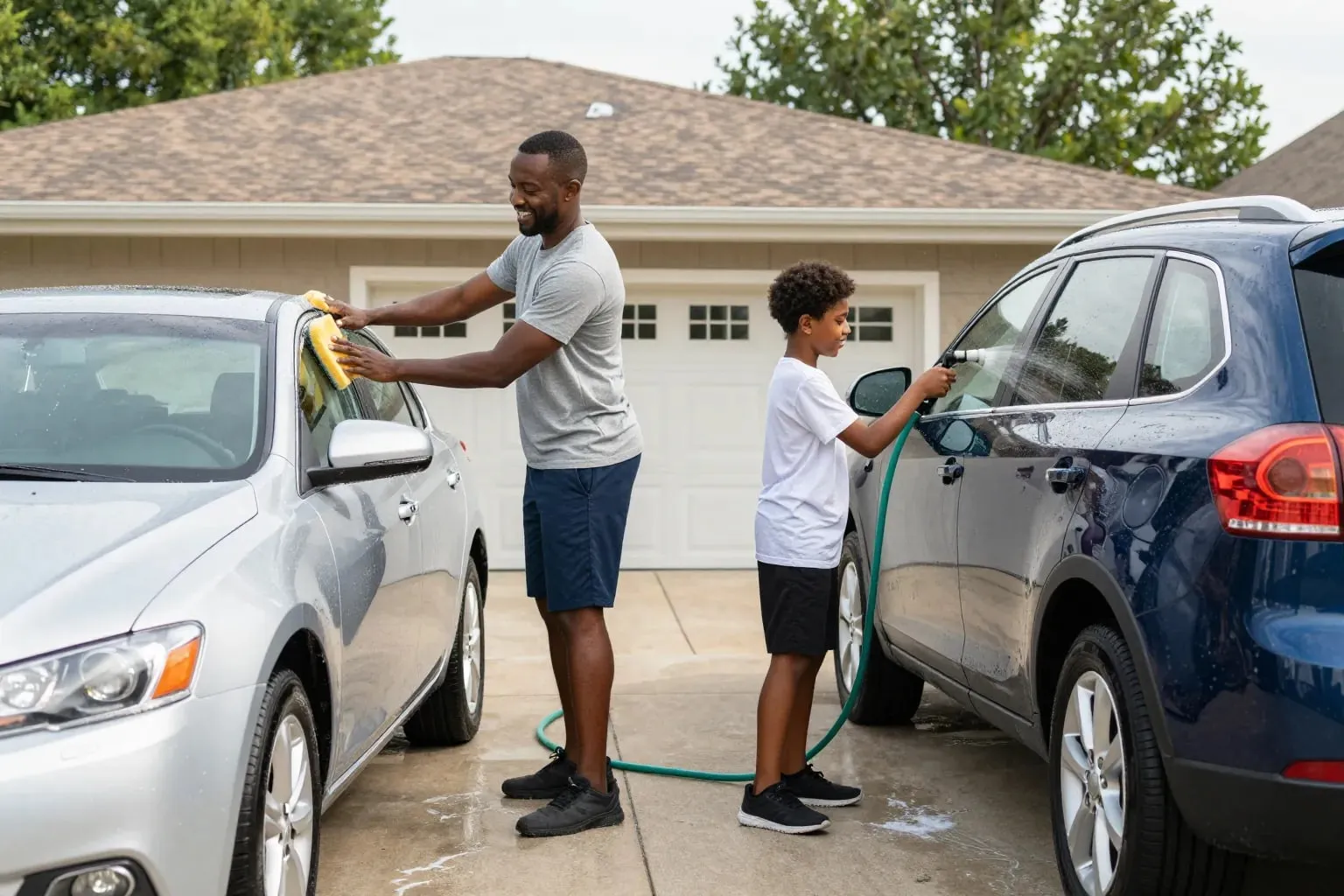
A family car policy has a bigger job than most people give it credit for. It protects the people riding in your cars, the other drivers you share the road with, and the savings and income your household depends on if a crash turns into a lawsuit. When you add a second or third car, a new teen driver or a grandparent who borrows the minivan on weekends, the decisions get more layered.
This page walks through how personal auto insurance works for households like yours, what each coverage does, what moves your price, and how our licensed agents help you put it together.
Is personal auto coverage right for your household?
A personal auto policy is designed for cars, SUVs, minivans and pickups that a household owns or leases and uses for everyday life: commuting, school drop-off, errands, road trips. It fits:
- Families with one or more cars who want limits that reflect what they actually have to protect.
- Multi-car homes where several drivers share several vehicles and you want everyone on one policy.
- Parents with a teen getting a permit or license, who need to plan coverage and cost before the first solo drive.
- Households with an older relative who still drives, or who lives with you and borrows a car.
You may need something different if:
- You drive for a rideshare or delivery app, or use a car mostly for business. A personal policy commonly excludes driving for pay. Our business-use auto page explains the endorsements and commercial options.
- Your state has told you to file an SR-22 or FR-44 after a DUI, a lapse in coverage or a serious violation. That filing changes which insurers will write you and what limits you must carry. See high-risk auto and SR-22/FR-44.
- The vehicle is titled to a business. Business-owned vehicles generally need a commercial policy.
How it works
Here is the path from first question to a policy in force, in plain English.
- List your drivers and vehicles. Every licensed household member and every car you own, lease or regularly use. Insurers rate each driver and each vehicle.
- Choose liability limits. Liability is written as three numbers, such as 100/300/100. The first is the most the policy pays for injuries to one person, the second is the most for all injuries in one crash, and the third is the most for property damage, all in thousands of dollars. Every state sets a minimum. California’s minimum, for example, rose to 30/60/15 in 2025 (California DMV (opens in a new tab)), and Virginia’s became 50/100/25 for policies effective on or after January 1, 2025 (Virginia DMV (opens in a new tab)). Minimums vary widely from state to state, and they are a floor, not a recommendation.
- Decide on protection for your own car. Collision and comprehensive cover damage to your vehicle. If you have a loan or lease, the lender will likely require both.
- Add protection for your family’s injuries. Uninsured/underinsured motorist coverage, plus PIP or MedPay depending on your state.
- Pick deductibles. The deductible is the amount you pay toward a collision or comprehensive claim before the policy pays the rest. Higher deductibles lower the premium; lower deductibles cost more but hurt less after a claim.
- Apply discounts and compare. Multi-car, multi-policy, good student, safe driver and other discounts vary by insurer and state. We compare the total price, not just the discount list.
- Bind the policy and get proof of insurance. Once you approve a quote, coverage starts on the effective date and you receive ID cards for each car.
- Review at renewal. Most personal auto policies renew every six or twelve months, which is a natural time to adjust.
Coverage breakdown
The terms below show up on almost every family’s declarations page (the summary page of your policy). The North Carolina Department of Insurance has a helpful plain-language overview of standard auto coverages (opens in a new tab) if you want a second reference.
| Coverage | What it pays for | Who it protects | Required? |
|---|
| Bodily injury liability | Injuries to others when you or a covered driver is at fault, plus legal defense | Other people, and your household’s assets | Required in nearly every state |
| Property damage liability | Damage you cause to other people’s cars, fences, buildings and property | Other people, and your assets | Required in nearly every state |
| Collision | Repairs to your car after it hits another vehicle or object, or overturns, minus your deductible | You | Optional by law; usually required by lenders |
| Comprehensive | Theft, fire, hail, flood, vandalism, animal strikes and broken glass, minus your deductible | You | Optional by law; usually required by lenders |
| Uninsured/underinsured motorist (UM/UIM) | Your household’s injuries (and in some states, car damage) when the at-fault driver has no or too little insurance | You and your passengers | Required in some states; optional in others |
| Personal injury protection (PIP) | Medical bills and often lost wages and other costs, regardless of fault | You and your passengers | Required in no-fault states |
| Medical payments (MedPay) | Medical and funeral costs for you and your passengers, regardless of fault, up to a set limit | You and your passengers | Usually optional |
| Rental reimbursement and roadside | A rental car while yours is in the shop; towing and jump-starts | You | Optional |
A few points families often ask about:
Uninsured and underinsured drivers are common. The Insurance Information Institute reports an estimated 14.0% of drivers were uninsured in 2022, about one in seven, with wide differences between states (III (opens in a new tab)). Underinsured drivers who carry only the state minimum add to that risk. UM/UIM is the coverage that protects your kids in the back seat when the other driver can’t pay. We cover it in more depth in Uninsured/Underinsured Motorist Coverage: Do You Need It?.
PIP depends on where you live. According to the III, twelve states plus Puerto Rico have no-fault auto laws: Florida, Hawaii, Kansas, Kentucky, Massachusetts, Michigan, Minnesota, New Jersey, New York, North Dakota, Pennsylvania and Utah. Three of those (Kentucky, New Jersey and Pennsylvania) let drivers choose whether to be bound by no-fault rules (III (opens in a new tab)). Outside no-fault states, MedPay plays a similar but usually smaller role.
Liability limits matter more as your household grows. Minimum limits can run out in a single serious crash, and anything above them may become your responsibility. Our guide Why State Minimum Liability Rarely Protects a Family explains why.
What affects your cost
We won’t quote a price range here, because premiums depend on details that differ from one household to the next. These are the factors insurers commonly use, though the exact mix and weight vary by company and some factors are restricted by state law:
- Driving records. Accidents and moving violations for every listed driver. Many insurers offer discounts for no accidents or violations over a period of years (III (opens in a new tab)).
- Driver age and experience. Teen drivers raise premiums because the data shows higher risk. IIHS reports that the fatal crash rate per mile driven for drivers ages 16 to 19 is roughly three times the rate for drivers 20 and older, with the highest risk at ages 16 and 17 (IIHS (opens in a new tab)).
- The vehicles. Price, repair costs, safety record and theft risk all play a part, which is why the III suggests checking insurance costs before you buy a car.
- Where the cars are garaged. Your ZIP code reflects local traffic, theft and claim patterns.
- Coverage choices and deductibles. Higher limits cost more; higher deductibles cost less. The III notes that raising collision and comprehensive deductibles can lower that part of the premium substantially.
- Annual mileage and use. Lower-mileage drivers may qualify for a discount.
- Credit-based insurance scores, where state law allows them.
- Discounts. Multi-car, home-and-auto bundles, good student, driver education, student away at college without a car, anti-theft devices and paying in full are common examples. Not every insurer offers every discount in every state.
For teen-specific strategies, read Adding a Teen Driver: What Raises the Rate and How to Bring It Down. For households juggling several cars, see Multi-Car Households: Bundling, Discounts and Coverage Gaps.
Key dates and timing
Auto insurance has no open enrollment season. You can buy or change a policy any time, but timing still matters:
- Before you drive a new car off the lot. Arrange coverage before you pick it up. Many policies give a short grace period for a newly acquired car, but the length varies, so confirm it.
- When your teen gets a permit or license. Insurers differ on which milestone triggers the requirement to add them. Ask before the first practice drive.
- At each renewal, usually every six or twelve months. Your insurer may change your rate at renewal, which is a good moment to re-shop.
- When a loan is paid off. You may choose to keep or drop collision and comprehensive once the lender no longer requires them.
- When you move, even across town. Garaging address affects price, and a move to another state means a new policy that meets that state’s rules.
- Before any lapse. A gap in coverage can raise future premiums and, in some states, lead to license or registration penalties.
What to have ready
Gather these before your consultation and the quote process goes much faster:
- Names, dates of birth and driver’s license numbers for every household driver
- Any accidents, tickets or claims in recent years for each driver
- Year, make, model and VIN for each vehicle
- Lender or lease company details, if any
- Your current declarations page (shows your existing limits, deductibles and renewal date)
- The address where each car is kept overnight, including a student’s college address
- Approximate annual mileage for each vehicle
- Report cards or driver education certificates for teen drivers, if you want to ask about those discounts
- Details on any home, renters or umbrella policy you might bundle
How Lanternhill helps
We’re a licensed insurance agency, so our licensed agents do the comparison work with you. There is no cost to work with us. Here is what that looks like:
- A conversation first. We start with your household: who drives, what you drive, what you own and what worries you. That shapes the limits we suggest.
- Coverage recommendations in plain English. We explain what each coverage does and why it matters for your situation, including UM/UIM, PIP or MedPay, and how deductibles trade off against premium.
- Side-by-side quotes. Where we can, we show you options with the same limits so you are comparing like with like, and we show bundled and unbundled pricing.
- Help with the paperwork. We walk you through the application, explain any exclusions or named-driver rules, and make sure ID cards are in hand before you need them.
- Annual review. Before each renewal, or whenever your life changes, we revisit limits, discounts and drivers so the policy keeps up with your family.
We can’t promise a particular price or that every insurer will accept every driver. What we can do is make sure you understand your choices and help you make a confident decision.
Common mistakes to avoid
- Buying only the state minimum. It satisfies the law but may leave your household exposed after a serious crash.
- Rejecting UM/UIM to save a little. It’s one of the few coverages that protects your own family when someone else is at fault and underinsured.
- Choosing a deductible you can’t pay. A high deductible lowers the premium, but only works if you can cover it the week after a claim.
- Forgetting to list a household driver. An unlisted regular driver can cause problems at claim time.
- Waiting until after the license test to call. Plan for your teen’s coverage in advance so there is no gap and no surprise.
- Keeping collision on a car worth very little, or dropping it on a car you couldn’t afford to replace. Run the numbers each year.
- Driving for an app on a personal policy without an endorsement. That gap can leave you with no coverage for a crash during a shift.
- Letting coverage lapse between policies. Line up the new policy’s start date with the old one’s end date.
Ready to review your family’s coverage?
Whether you’re adding a teen, buying another car or just want a second look at what you carry, our licensed agents can help you understand your options and compare quotes. Book a free consultation with a licensed agent and bring your current declarations page. If you have a quick question first, you can always reach us here.
 Limits sized to your household