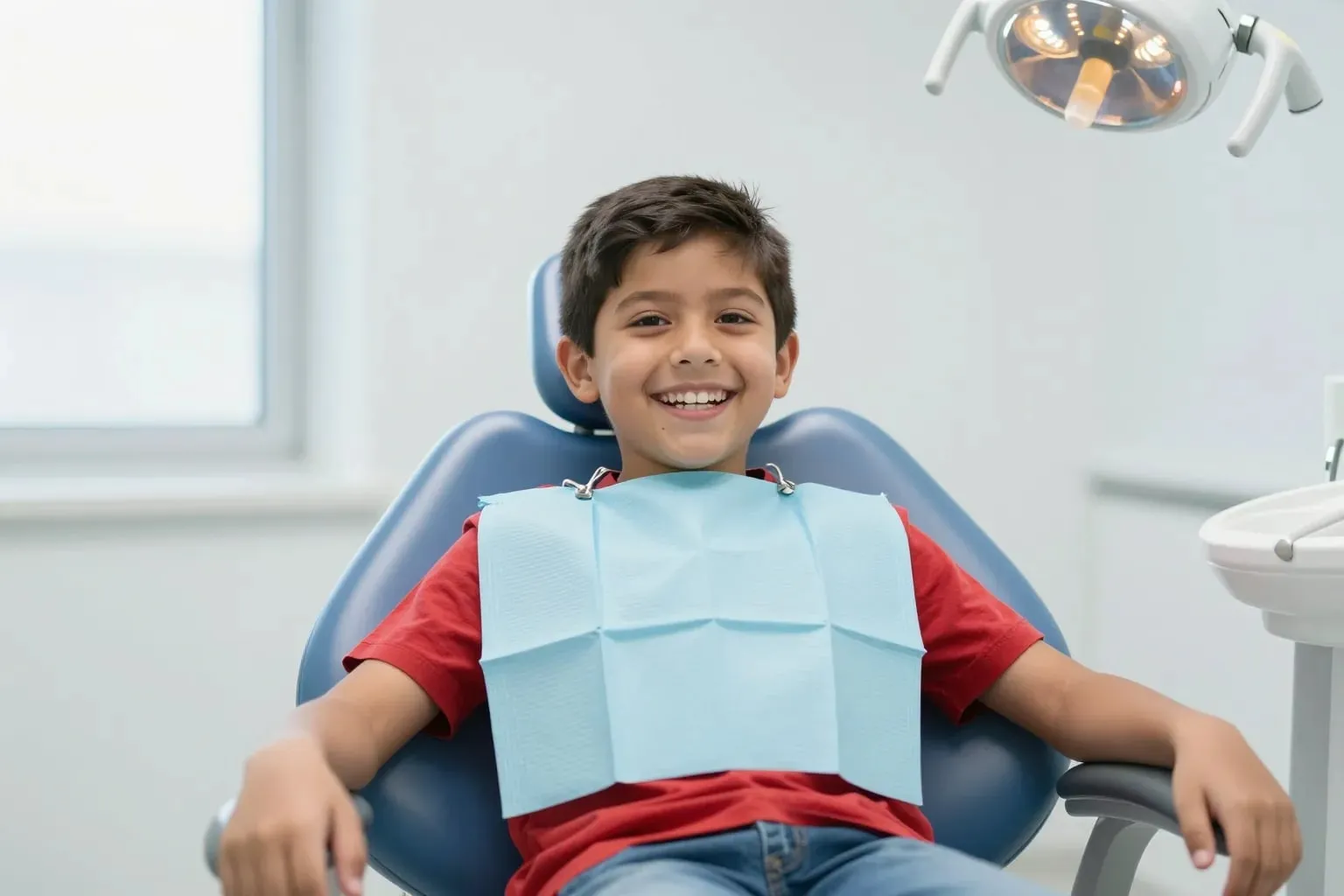
Dental and vision care for children are both essential health benefits under the Affordable Care Act, but they show up differently. Every Marketplace health plan includes vision coverage for kids. Dental coverage for kids must be available, yet it may be built into the health plan or sold as a separate stand-alone dental plan, and you aren’t required to buy it. So the real job for parents is checking, plan by plan, where the children’s dental coverage lives and what it costs.
Below, we explain what’s typically included, how the two dental setups differ and what to look for before you enroll.
What “essential health benefit” means for your kids
The Affordable Care Act lists ten essential health benefits, categories of care that Marketplace plans must cover. One of them, according to HealthCare.gov (opens in a new tab), is “pediatric services, including oral and vision care.” HealthCare.gov’s dental page (opens in a new tab) applies the children’s dental benefit to kids 18 and under.
Being an essential benefit doesn’t mean every detail is identical nationwide. Each state picks a benchmark plan, a model plan that sets the specific services insurers in that state must cover. That’s why a pediatric dental or vision benefit can look a little different in one state than in the next.
Pediatric vision: included in every Marketplace plan
HealthCare.gov states plainly that all Marketplace plans include vision coverage for children. Adults are a different story; only some plans include adult vision.
What’s covered depends on your state’s benchmark. According to Prevent Blindness (opens in a new tab), most states base their pediatric vision benefit on the federal employee vision program, which includes an annual eye exam and one pair of eyeglasses per year. A handful of states use their CHIP vision benefit or their own benchmark instead. The organization’s summary draws on the original state benchmark choices, so confirm the current details in your plan documents.
Separately, the medical side of your plan covers vision screening for children as a preventive service. HealthCare.gov (opens in a new tab) lists vision screening among children’s preventive services that are generally covered at no cost when you use an in-network provider. A screening at a well visit is not the same as a full eye exam, so if the pediatrician flags a concern, you’ll use the vision benefit for the exam and glasses.
Questions worth asking about any plan’s pediatric vision benefit:
- Which eye doctors are in network? Vision benefits sometimes use a separate network from the medical plan.
- Are contact lenses covered in place of glasses, and under what conditions?
- What frames are included, and what happens if your child picks something outside that selection?
- How often can a child replace lost or broken glasses?
Pediatric dental: embedded or stand-alone
This is where families most often get caught off guard. Children’s dental must be available in the Marketplace, but federal rules let it be offered two ways.
| Embedded in the health plan | Stand-alone dental plan (SADP) | |
|---|---|---|
| How you get it | Comes with the medical plan automatically | Separate policy you choose and add |
| Separate premium? | No; included in the health plan premium | Yes; its own monthly premium |
| Deductible | May be subject to the medical plan’s deductible, though some plans cover preventive dental first | Usually its own, separate deductible |
| Out-of-pocket limit | Counts toward the medical plan’s out-of-pocket maximum | Has its own, generally much lower annual limit for pediatric benefits |
| Network | The plan’s dental network | The dental insurer’s own network |
| Can you skip it? | It’s part of the plan | Generally yes; it’s optional on HealthCare.gov |
Sources: HealthCare.gov (opens in a new tab) and healthinsurance.org (opens in a new tab).
How to tell which one you’re looking at
When you compare plans on HealthCare.gov or a state Marketplace, open the plan details and look for “dental coverage for children” or “pediatric dental.” The plan’s Summary of Benefits and Coverage has a row titled “If your child needs dental or eye care,” which shows children’s eye exams, glasses and dental checkups. If the plan says it isn’t covered, you’ll need a stand-alone dental plan to get it. Our guide to reading a Summary of Benefits and Coverage shows where that row sits.
A few states handle this differently, for example by requiring every Marketplace health plan to embed pediatric dental, or by requiring families with children to buy it. Check your state Marketplace’s rules or ask us.
Watch the deductible on embedded dental
An embedded benefit sounds simpler, and often is. But if dental care falls under the medical deductible, a filling or extraction might be billed at full price until you’ve met a deductible of several thousand dollars. Some plans cover preventive dental visits before the deductible; others don’t. Read the cost-sharing details, especially on bronze plans. Our post on what metal tiers mean for a family budget explains how deductibles change across tiers.
Braces and orthodontia
Pediatric dental benefits generally cover orthodontia only when it’s medically necessary, meaning it treats a real functional problem rather than a cosmetic one. Each plan defines that differently, and many require prior approval. If your child may need braces, ask for the plan’s criteria in writing before you enroll.
Buying a stand-alone dental plan
Three rules to know:
- It has to come with a health plan. HealthCare.gov says you can’t buy a Marketplace dental plan unless you’re buying a health plan at the same time.
- Timing follows the health plan. You’ll generally add one during Open Enrollment or when a Special Enrollment Period lets you enroll in health coverage.
- Tax credits are limited. The IRS Form 8962 instructions (opens in a new tab) say a stand-alone dental plan isn’t a qualified health plan for premium tax credit purposes on its own, but the portion of its premium for pediatric benefits is included in the tax-credit calculation. In practice, whether it lowers what you pay depends on your situation. Our guide to how household size and income change what you pay covers the basics.
Preventive dental care your medical plan covers
Even when dental insurance is separate, the medical plan covers some oral health services for young children as preventive care. HealthCare.gov (opens in a new tab) lists:
- Fluoride varnish for infants and children once teeth appear
- Fluoride supplements for children whose water source lacks fluoride
- An oral health risk assessment for children from 6 months to 6 years
These are typically done at the pediatrician’s office during well visits, so ask about them at your next appointment.
If your kids have Medicaid or CHIP
Children on Medicaid receive dental services through EPSDT (Early and Periodic Screening, Diagnostic and Treatment), Medicaid’s comprehensive benefit for kids. Medicaid.gov (opens in a new tab) says that at minimum it must include relief of pain and infections, restoration of teeth and maintenance of dental health, and that services must be provided when medically necessary.
Separate CHIP programs must also cover dental care, including services to prevent disease and promote oral health, restore teeth and treat emergencies, according to Medicaid.gov’s CHIP benefits page (opens in a new tab). You can apply for Medicaid or CHIP any time of year, and a Marketplace application will tell you if your kids appear to qualify.
What about the parents?
Adult dental and vision are not essential health benefits, so health plans don’t have to include them. CMS’s 2027 payment rule (opens in a new tab) went further and bars insurers from counting routine adult dental services as an essential health benefit. If parents want regular cleanings, fillings or glasses covered, a separate dental or vision policy is the usual route. Our supplemental health page explains how those policies work alongside your medical plan.
Your dental and vision checklist
- For each plan, note whether pediatric dental is embedded, and if not, which stand-alone dental plans are available.
- Check whether embedded dental is subject to the medical deductible.
- Confirm your child’s dentist and eye doctor are in the right networks (they may differ from the medical network).
- Ask about orthodontia rules if braces are likely in the next few years.
- Review the pediatric vision benefit for exams, glasses, frames and contacts.
- Decide whether parents need separate dental or vision coverage.
- Add up total costs: health premium, any dental premium and likely out-of-pocket spending.
Timing for 2027 coverage
Open Enrollment for 2027 Marketplace plans runs from November 1, 2026, through January 15, 2027, on HealthCare.gov (opens in a new tab). Enroll by December 15 for coverage starting January 1. State Marketplaces may set different dates. If your family is growing mid-year, our post on adding a newborn to your health plan covers the deadlines, and our individual and family health plans page explains how we compare options.
Next step
Sorting out where your kids’ dental and vision coverage lives can take an hour of clicking through plan details. A licensed agent can do it with you in a fraction of the time and show you the total cost side by side. Book a free consultation; there’s no cost to work with us.
Frequently asked questions
Do all Marketplace health plans include dental coverage for kids?
No. Dental care for children is an essential health benefit, which means it must be available to you, but it can be offered either inside a health plan or as a separate stand-alone dental plan. HealthCare.gov also notes that you don't have to buy children's dental coverage. Check each plan's details to see whether pediatric dental is included.
Do Marketplace plans include vision coverage for children?
Yes. HealthCare.gov states that all Marketplace health plans include vision coverage for children. What that covers depends on your state's benchmark plan, but in most states it is modeled on a federal employee vision program that includes a yearly eye exam and one pair of glasses per year.
Can I buy a stand-alone dental plan on the Marketplace without a health plan?
Not on HealthCare.gov. You can't buy a Marketplace dental plan unless you're also buying a Marketplace health plan at the same time. If you already have health coverage elsewhere, you can look at dental plans sold outside the Marketplace.
Does pediatric dental cover braces?
Usually only when orthodontic treatment is medically necessary, not for cosmetic reasons. The definition of medically necessary varies by plan and state, so ask the plan for its criteria and any prior authorization rules before your child starts treatment.
Are dental and vision covered for parents too?
Not as a requirement. Adult dental and vision are not essential health benefits, so health plans don't have to include them. CMS's 2027 rule also bars insurers from counting routine adult dental as an essential health benefit. Many families add separate dental or vision policies for the adults.
Sources
- HealthCare.gov — What Marketplace health insurance plans cover (opens in a new tab)
- HealthCare.gov — Dental coverage in the Marketplace (opens in a new tab)
- HealthCare.gov — Preventive care benefits for children (opens in a new tab)
- IRS — Instructions for Form 8962, Premium Tax Credit (opens in a new tab)
- Medicaid.gov — Dental care (opens in a new tab)
- Medicaid.gov — CHIP benefits (opens in a new tab)
- CMS — HHS Notice of Benefit and Payment Parameters for 2027 Final Rule (fact sheet) (opens in a new tab)
- Prevent Blindness — Pediatric vision benefits available under the Affordable Care Act (opens in a new tab)
- Healthinsurance.org — Is pediatric dental coverage included in Marketplace health plans? (opens in a new tab)
- HealthCare.gov — Dates and deadlines (opens in a new tab)